
Win decades, not days
Lately, I’ve been noticing the same pattern in some very different places.
Ben Stokes retired from international cricket after four years captaining England’s Test team. Gary Stevenson recently announced he was stepping away from the YouTube channel he had built to 1.6 million subscribers, saying the pressure was damaging his health.
Jacinda Ardern resigned as New Zealand’s Prime Minister saying, “I no longer have enough in the tank.” And Japan’s Prime Minister, Sanae Takaichi, has spoken publicly about sleeping as little as zero to three hours a night.
Different people, different fields, but the same underlying problem:
You can get extraordinary results for a while using a way of working you cannot sustain.
Most workplaces reward winning the day. Hit the deadline, make the quarter, take on another project, push through the difficult patch.
Sometimes that is necessary. The problem is when temporary intensity becomes your permanent operating system.
There are really two questions:
Does this way of working get results? Can I keep working this way?
The answer for many people is Yes + No.
Try this: five warning lights
People rarely go from thriving to burned out overnight. Usually the signs appear much earlier.
To avoid the slide, keep an eye on these 5 signals:
Meaning: Is the work I’m doing still connected to something that matters to me?
Energy: Does some of my work give me energy back, or does almost all of it take energy away?
Growth: Am I still learning and stretching, or mostly repeating familiar patterns?
Switching off: Can my mind properly leave work when the working day ends?
Recovery: Do I regularly restore myself, or only stop once I’m depleted?
You do not need to be struggling on all five. But if two or three are consistently running in the red, I would pay attention.
One lawyer we interviewed after burning out put it memorably: “Once the pot burns black, it’s hard to bring it back.”
From our research: build an opposite world
One of the best strategies we learned in our research showed up often enough that we gave it a name: an opposite world.
We first heard it from Vivek Rao, a product leader at a large tech company. “Work here is intense,” he told us. “Anyone who lasts three years is a veteran.” Vivek had lasted more than ten.
One reason was Argentine Tango.
At work, Vivek lived largely in his head: logic, decisions, speed. In tango, he was in his body and his heart. At work, status mattered. In tango, none of it mattered. For a few hours, his work identity disappeared and his brain properly disengaged.
Once we knew to look for it, we started seeing versions of this everywhere: a COO who plays bagpipes, an investment banker who quilts, a project manager who swims in the ocean, and a doctor who digs fence posts. For me, it is smoking Texas barbecue.
The activity seems to vary for different people. They key is having somewhere to go where the part of you that performs all day is no longer required.
What’s your opposite world?
One thing to read
Burn Bright on the cover of the Listener
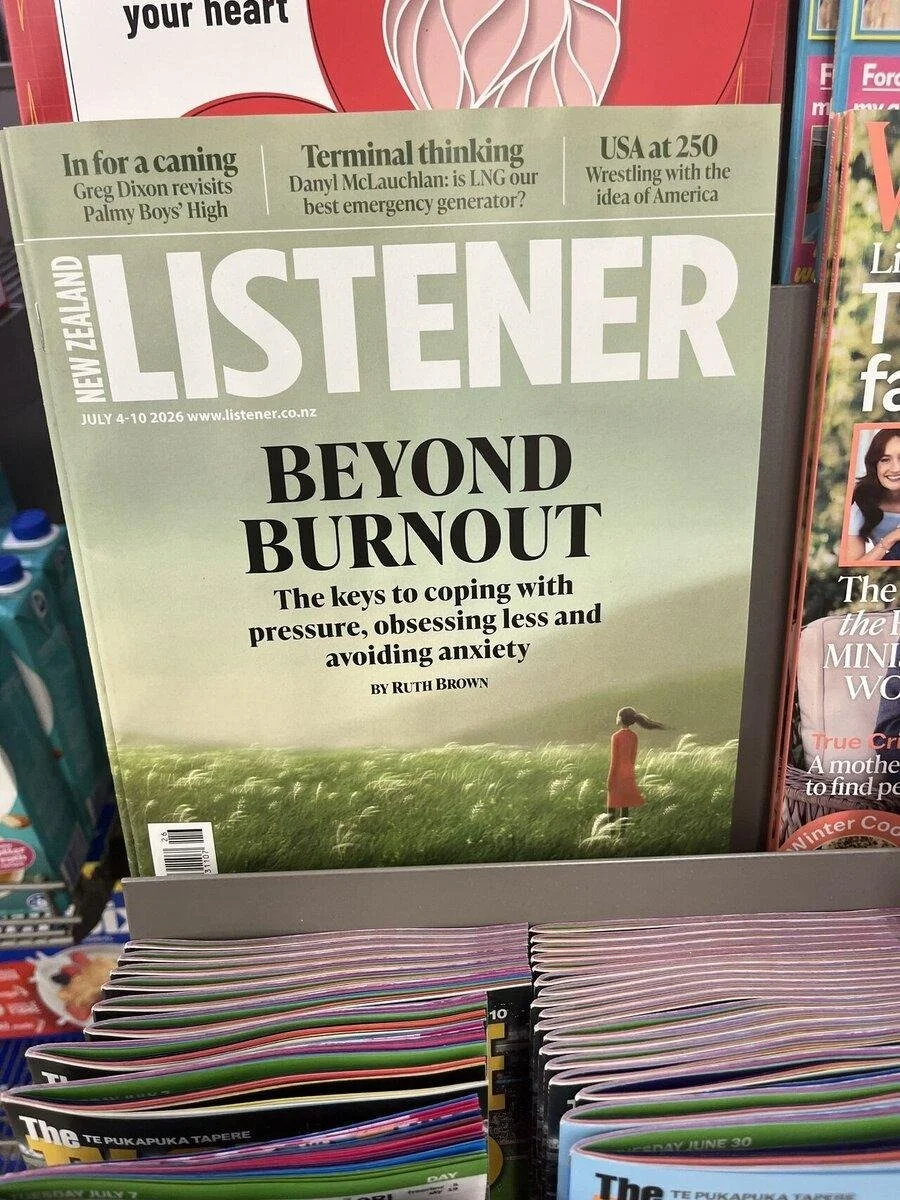
I recently sat down with journalist Ruth Brown for what I thought would mainly be a conversation about the book. It went much further back, into some of the experiences that first got me interested in pressure, stress and sustainable performance.
The piece ran under the headline “Beyond Burnout” and is available online. There are 10 free gifted copies in the link below
Book update
Burn Bright is now available in the US
The global rollout happened in stages, so for months I’ve had people in the US asking when they could actually order the book. As of now, they can.
The book grew out of the Thrivers Study: five years identifying and testing the strategies most likely to help people sustain high performance, refined inside 15 real organisations. The strongest and most practical of them became the 10 habits in Burn Bright.
The most common thing readers tell me is that it is practical and easy to read. Someone recently told me they read the whole thing in a day. I’m still working out whether an author should take that as a compliment, but for a book written for overloaded people, I’ll take it.
Available now: Order here
And if you’ve read Burn Bright and found it useful, I’d be hugely grateful if you left a short review on Amazon or Goodreads. Reviews make a big difference, so if you have got a few moments, I’ll thank you for it. A few lines is enough.
Cheers,
Nick
