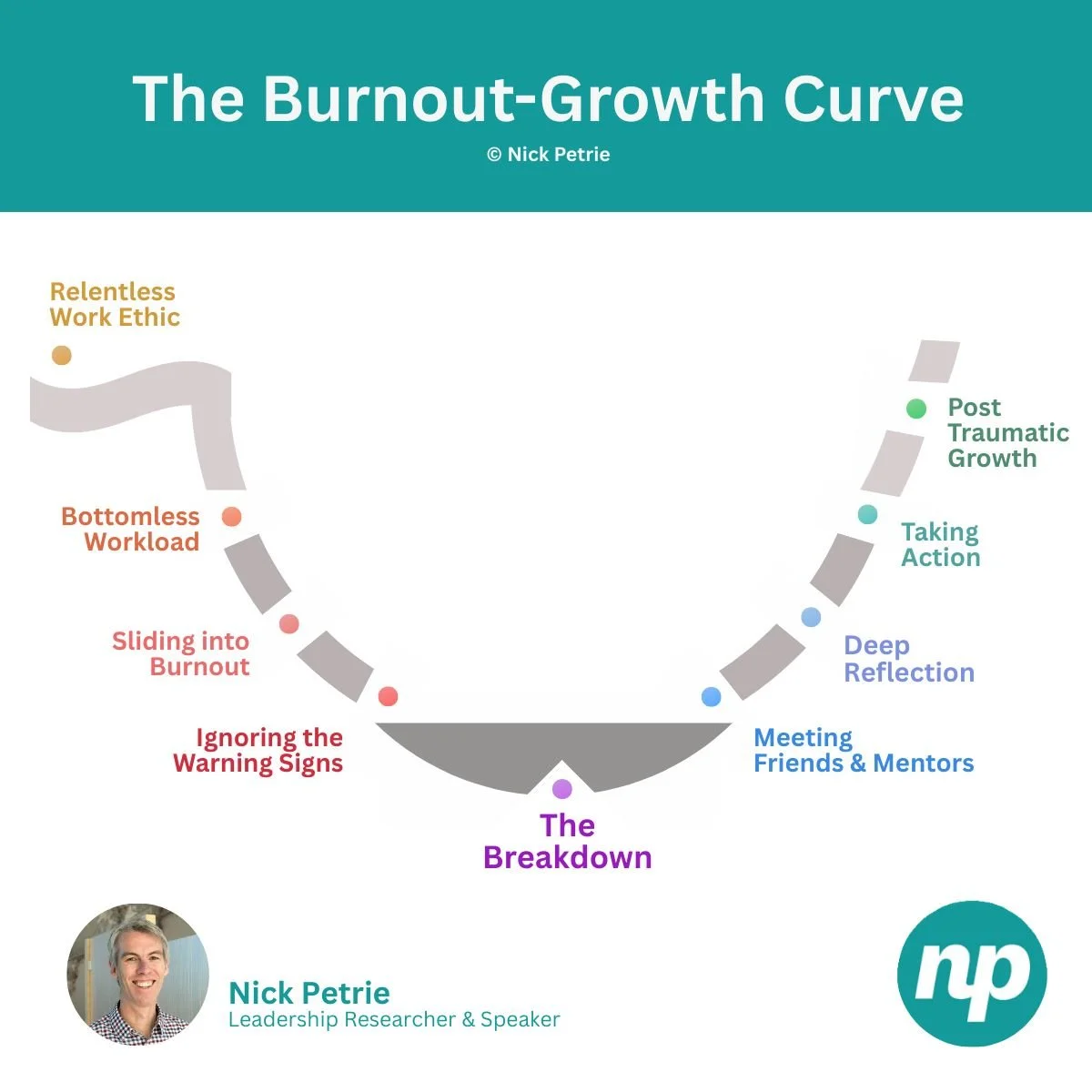
The Burnout-Growth Curve
Burnout and recovery have a pattern.
In our team's five-year field study across global organisations, the people who burned out told remarkably similar stories.
Here’s the pattern we kept seeing:
1. Relentless work ethic
“I'll deliver.”
“I won’t let people down.”
“I'll give 100%.”
2. Bottomless workload
Organisations rewarded that ethic with more work.
The harder they worked, the more work they were given.
3. Sliding into burnout
Work thoughts became constant.
Switching off became difficult.
Life narrowed.
4. Ignoring warning signs
Tension. Irritability. Exhaustion.
The body sent signals.
But slowing down wasn't an option.
5. The breakdown
For those who would not listen, the body intervened.
People couldn’t find the energy.
Couldn’t control emotions.
Couldn’t function
Their system closed down.
The trap?
Believing that rest was the solution.
Many people took a break: a week, a month, sometimes a year.
Then they returned to:
the same workplace
with the same beliefs
and the same ways of working
And got the same result.
But the people who truly overcame burnout followed a different path.
They:
Sought new perspectives (mentors, coaches, therapists)
Reflected deeply on what was driving them
Took new actions, big and small
Experimented with boundaries, hobbies, career shifts
They evolved their identity. It wasn't just about energy
When they returned, they changed how they worked. Not just how long they rested.
Two years later, many described something unexpected:
Growth.
“Post-traumatic growth is absolutely what happened to me. I had to outgrow my old self.”
The solution to burnout isn’t rest. It is growth.
While rest may be necessary, it is not sufficient.
The stages of burnout are consistent.
But they are not inevitable.
Look for the signals that your current way of working can't sustain.
That you need to find a new and different way.
This is the path to growth.
Sustainable high performance isn’t about working less.
It’s about developing habits that help you perform, while also protecting your energy, identity and boundaries in an always-on world.
But what the individual does is only half the equation.
Organisations need to create healthy conditions for individuals to perform in.
Our team has been studying what organisations can do over the last two years. I’ll share more of what this looks like in future posts and the upcoming book, Burn Bright: 10 habits for sustaining high performance in an always-on world.